
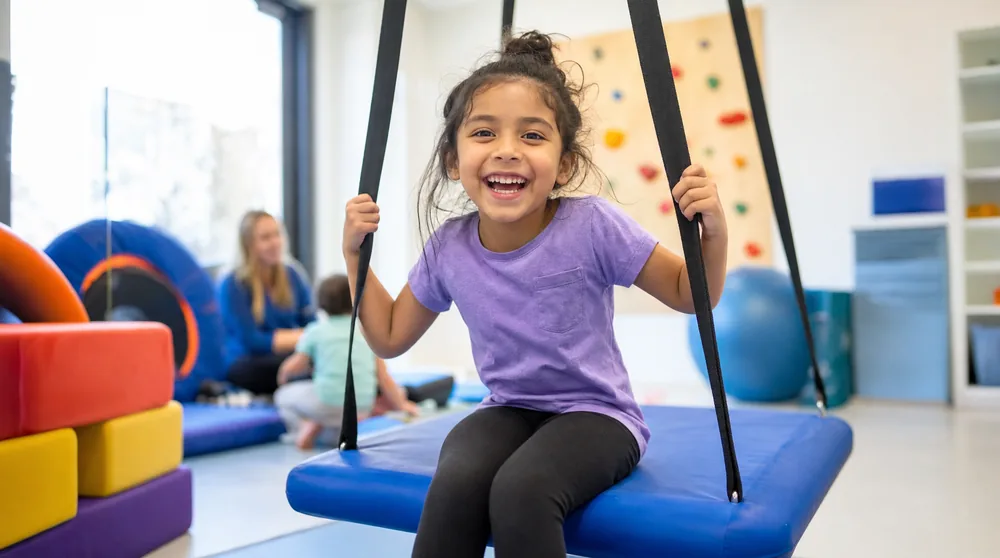
Walk past a sensory gym and it looks like the world's best playroom: swings hanging from the ceiling, crash pads, a climbing wall, bins of things to squish and pour. It is easy to file it under “fun extra.” It is not. For many kids, especially neurodiverse kids, what happens in that room is the difference between a brain that can learn and a brain that spends the whole day just trying to cope.
Here is what a sensory gym actually is, what each piece of equipment is doing, and why we built one into the middle of our Houston Micro School instead of treating it as a field trip.
What is a sensory gym?
A sensory gym is an indoor space designed to give children specific kinds of sensory input on purpose. Where a playground is built for entertainment, a sensory gym is built for regulation: helping a child's nervous system reach the calm, organized, alert state where focus, language, and learning become possible.
The design targets three sensory systems most people never learned about in school, because they are not among the famous five:
- Vestibular (the inner ear): the sense of movement and balance. Fed by swinging, spinning, rocking, and rolling.
- Proprioception (muscles and joints): the sense of where your body is and how hard it is working. Fed by pushing, pulling, climbing, jumping, and deep pressure.
- Tactile (the skin): touch, texture, and pressure. Fed by everything from bean bins to weighted blankets.
When those systems are underfed or overwhelmed, you see it as behavior: the child who cannot sit still, the child who crashes into everything, the child who covers their ears in the cafeteria, the child who dissolves at 4 pm over a broken crayon. A sensory gym is where those systems get what they need, deliberately.
A tour of the equipment, and what each piece is really for
Swings
The centerpiece of any sensory gym, and not for nostalgia. Slow linear swinging is one of the most reliably calming inputs to the vestibular system, while faster or rotational swinging is alerting for kids who are sluggish or under-responsive. Different swings do different jobs: a platform swing challenges balance, a pod or hammock swing adds cozy deep pressure, a bolster swing builds core strength while it soothes.
Crash pads and mats
Jumping and crashing into a thick pad delivers a burst of proprioceptive input, which is the nervous system's most dependable “organize and settle” signal. This is why so many kids who seem wild actually calm down after crashing: the input they were chasing all over your living room is finally available in a safe, contained form.
Climbing equipment
Climbing combines heavy muscle work, motor planning, and balance in one activity. It asks the brain to sequence, the body to organize, and the hands and eyes to cooperate, which is the same integration a child needs to sit upright at a table and write.
Trampolines
Rhythmic jumping delivers steady vestibular and proprioceptive input at the same time. For many kids ten minutes of jumping buys an hour of focus, which is a trade any teacher would take.
Tactile stations and calm corners
Texture bins, fidgets, weighted lap pads, and a dim, quiet corner for the moments a child needs less input, not more. A good sensory gym works in both directions: it can rev a sluggish system up and bring an overwhelmed system down.
It looks like play. Why is it not just play?
The difference is intention. In a sensory gym, adults who know the child are reading their state and steering: this child needs heavy work before handwriting, that child needs slow swinging after a loud morning, this one is ready to be challenged on the climbing wall. The equipment is the medium. Regulation is the goal.
This is the same logic occupational therapists use in sensory integration therapy, and many sensory gyms exist inside OT clinics. The limitation of the clinic model is scheduling: a child gets that environment for 45 minutes on a Tuesday, then spends the rest of the week in rooms that were not built for their nervous system.
Why we put a sensory gym inside a school
Here is the belief that shaped our building: regulation comes before reading. A dysregulated brain cannot take in phonics, no matter how good the phonics instruction is. So instead of treating sensory needs as something families handle after school, we built the sensory gym into the school day at our Micro School.
In practice, that looks like:
- Movement before academics, so kids arrive at the table with their sensory tanks filled rather than running on empty.
- Sensory breaks on each child's schedule, not only when a meltdown forces the issue. With groups capped at four scholars, staff can see a child climbing toward overwhelm and route through the gym before it crests.
- Learning inside the gym itself. Counting while jumping, spelling from a swing. For plenty of kids, moving and learning are not competing activities, movement is the doorway.
Does my child need a sensory gym?
Nearly every young child benefits from rich movement and sensory input. But a sensory gym tends to matter most if you recognize your kiddo in lines like these:
- Constantly moving, crashing, climbing, or chewing.
- Overwhelmed by noise, lights, tags, or crowded rooms.
- “Fine at school, falls apart at home,” the classic sign of a child spending all day white-knuckling it.
- Avoids playgrounds, swings, or messy play entirely.
- Struggles to settle for tabletop work despite being bright.
Both the sensory seekers and the sensory avoiders on that list are telling you the same thing: their nervous system needs more deliberate support than a standard classroom offers.
The bottom line
A sensory gym is not a perk. It is infrastructure for the nervous system, the way a library is infrastructure for reading. If your child is neurodiverse, the question worth asking any school is not “do you have sensory equipment?” but “how is sensory regulation built into an ordinary Tuesday?”
Ours is built into every day, for every scholar, in a purpose-built space down the hall from the classroom. If you would like to see it, and see what your kiddo does the first time they spot the swings, come visit.